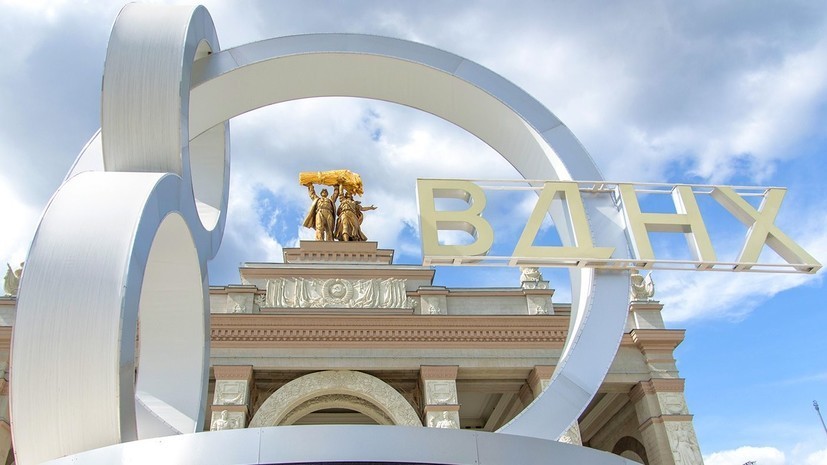
VDNH in numbers
The largest exhibition, Museum and recreational complex in the world
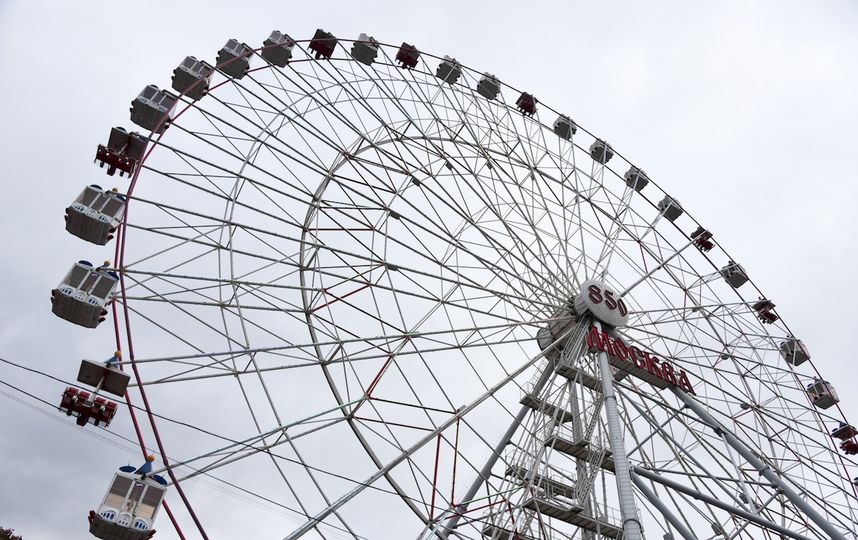
One of the most popular public spaces in Moscow
325 hectares with historical pavilions, arches, museums, ponds, parks, alleys, fountains, flower beds, sculptures
49 cultural heritage sites
33 million visitors annually
The 80th anniversary of VDNH was celebrated on August 1-4, 2019
What is VDNH?
The exhibition of achievements of the national economy is the largest exhibition, Museum and recreational complex in the world. Since its opening on August 1, 1939, the name has changed several times — VSHV, VDNH of the USSR, VVC. Today VDNH is a unique space for Museum and exhibition projects, international business exhibitions and congresses, festivals and holidays.
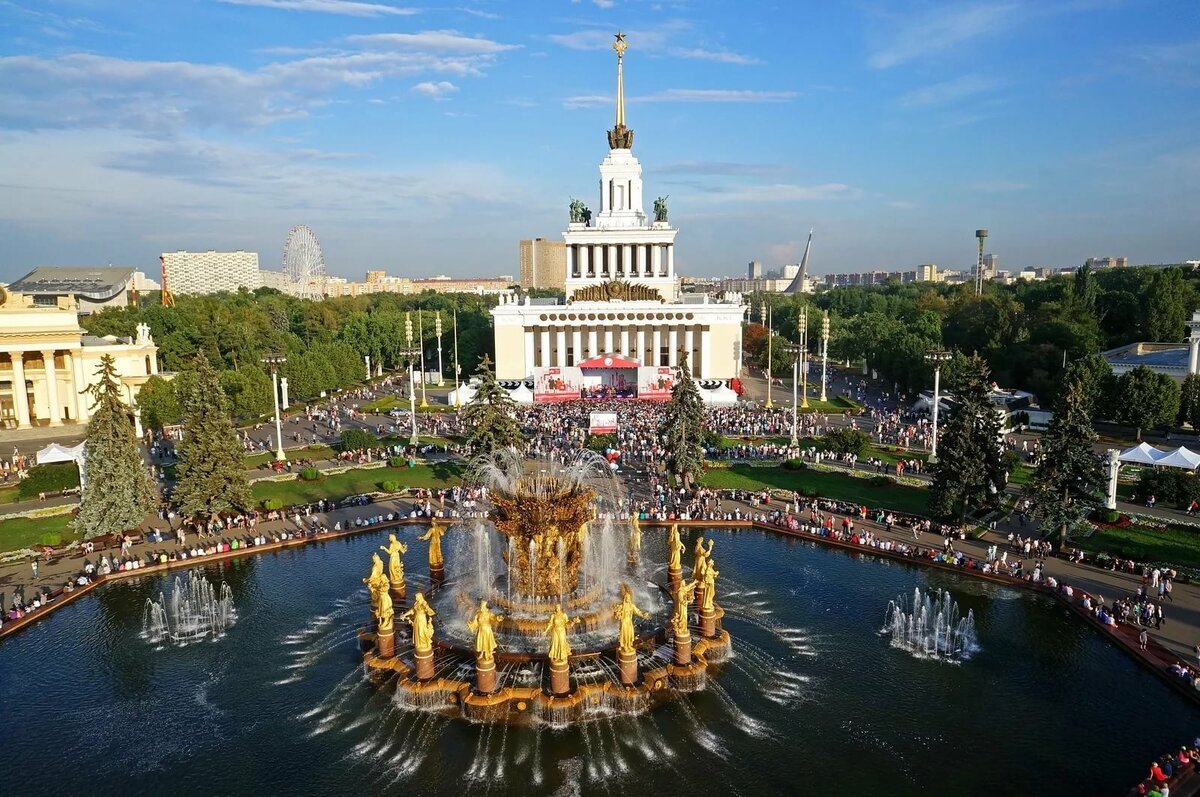
It is at VDNH that you can see outstanding architectural masterpieces, which together represent a monument to the Soviet era and a sample of the prevailing styles at different times. Among them are the monument "worker and collective farmer", fountains "Friendship of peoples" and "Stone flower", pavilions "Agriculture", "Soviet culture", "Cosmos" and others.
VDNH is conceptually divided into seven zones:
1. The Central Avenue of the exhibition space of "the Museum city»
2. All-season theme Park
3. Knowledge Park
4. Landscape park
5. Craft Park
6. EXPO zone
7. Ostankino Park»
VDNH for walking
The Ostankino Park with an area of 75.6 ha belongs to the VDNH complex.it is one of the oldest parks in Moscow.
The VDNH Landscape Park is considered the "green heart of the capital". This is a unique open-air eco-complex. The historical natural landscape is combined with the latest developments in landscape architecture and landscaping.
According to the style, content, zoning and methods of landscape design, the complex becomes one of the most famous landscape parks in the world. At the same time, the entrance to the VDNH Landscape Park will remain free of charge.
The Park covers an area of 87.3 hectares. It consists of five natural zones that symbolize the transition from wild to man-made nature: "nature Botanical", "nature entertainment", "Nature wild", "nature cultivated" and "Nature of Sciences and arts". Each of them conceptually fills VDNKH with modern content, preserving the architectural heritage, historical and natural purpose.
The author of the Park concept is the world-famous French architect Michel Pena.
The landscape Park is a place for secluded outdoor walks where you can hide from the noise of alleys, arrange a "reset in the city".
There are several cultural heritage sites inside the Park. This is the cascade of Kamenskiye ponds, Michurinsky garden, created in 1936, which is famous for its cherries, pears and Apple trees, flower panoramas of tulips, begonias, petunias and violas, an Oak grove with the only aerial ecotrope in Moscow. Other attractions in the Landscape Park include a green chessboard-shaped maze with an area of more than 1,000 square meters. Its walls will form a hedge of trees and shrubs of various breeds.
VDNH in the warm season is drowned in flowers. Guests ENEA can see here the white alyssum, Cannes, blue verbena, cineraria grey and blue Salvia — a total of more than 20 thousand flowers.
VDNH is the only public space in Moscow where you can see Manchurian apricot, Amur maakia, clematis, deer-legged sumac or vinegar tree. The exclusive Exhibition is also considered to be cucumber Magnolia.
Behind the Central pavilion, between the fountains "Friendship of peoples" and "Stone flower", located flower beds. Its patterns were restored from drawings from the 1950s. Recreated flower stalls were awarded the "Moscow restoration-2017" award.
The North and South rose gardens are also a great place to walk. The Northern rose garden with an area of more than 200 square meters stretches from the Central pavilion to pavilion 71. Its composition consists of 21 flower beds. The southern rose garden covers an area of more than one and a half thousand square meters. It has been restored to its historical layout. About 12 thousand plants were planted here — 500 thousand roses, yellow daylily, several types of sage, Bonar verbena, and Catnip. The rose gardens have benches for relaxing and wide paths for walking. Stepping off them onto gravel paths, visitors will be able to see flower patterns up close.
The history of VDNKH
1935-1941 years
The decision to build the all-Union agricultural exhibition (vskhv) was made at the Second all-Union Congress of collective farmers. It was supposed to open for the 20th anniversary of the Soviet government for 100 days. The idea of the Exhibition was largely symbolic. To prove the success of collective farm construction, it was decided to create abundance in the fenced territory of Ostankino Park.
In the second half of 1935, construction began. Buildings made of typical wooden parts were built slowly. But by July 1937 had already been ready the pavilions of Belarus, Ukraine, the common pavilion of the Transcaucasian republics, Tatarstan, Turkmenistan, mechanization, the Main pavilion, pavilion beet, vegetables etc. the Opening was postponed for a year because in time for the anniversary of Soviet power failed. Temporary wooden pavilions, designed for 100 days, were redesigned so that they could stand for five years (later this period will be extended indefinitely). At the same time, traces of modernism were eliminated. By the appointed time again did not have time and announced a new opening date — August 1, 1939.
In July 1938, Vera Mukhina's sculpture "worker and collective farmer" was brought from the exhibition "Expo-37"in Paris. In less than a month, the monument was installed on the driveway to the main entrance of the VSHV. Instead of the original 34-meter pavilion-pedestal, as in Paris, the sculpture was installed on a 10-meter cube, which significantly distorted the overall architectural appearance of the monument.
Among the pavilions built by this time, some were reconstructed, improved, and supplemented with new architectural delights. Exhibition halls began to display the most characteristic features of the national style of each of the Union republics, as well as the regions of the RSFSR. The forgotten and inconspicuous wasteland of the North-Eastern border of Moscow turned into a unique exhibition city, where 52 different pavilions and 200 different buildings were presented on 136 hectares.
On August 1, 1939, the all-Union agricultural exhibition was finally inaugurated. The ceremony was attended by 10 thousand people, and in the first 85 days of the VSHV saw more than 3.5 million visitors.
The exhibition has become a familiar place of recreation for Muscovites and tourists. It continued to operate almost unchanged until the German invasion of the USSR.
1941-1945. great Patriotic war
On July 1, 1941, by order of the Council of people's Commissars of the USSR, the Exhibition was closed. All the cattle presented by the collective farms and state farms for display at the VSHV were promptly removed. The rest — the unique collection of the VSHV library, the photo lab and the archive-was evacuated to Chelyabinsk. The pavilions were preserved. Of the staff, only people remained to guard and maintain the remaining exhibits. Other employees of the Exhibition went to the front. 127 of the 260 employees of the all-Union agricultural exhibition who went to the people's militia of the 13th Rostokinsky division were killed. On July 10, 2019, a monument was unveiled at VDNH in their honor.
On the basis of the production and technical workshops of the VSHV, the workshops of the military repair plant No. 20 were placed. In one day, up to 60 motorcycles were assembled on its Assembly lines for the front. Almost the entire housing stock of the VSHV during the second world war was occupied by workers and employees of military-defense enterprises.
After the war
In 1948 the Council of Ministers has decided to revive the agricultural exhibition in 1950. But the reconstruction took not two years, but six. The opening took place only in 1954. By this time, the Exhibition area had grown to 207 hectares.
Several fountains appeared: "Friendship of peoples", " Stone flower "and"Golden ear". A five-kilometer highway with trolleybus traffic was built. Most of the pavilions were rebuilt. The planning structure of the Exhibition has changed, so the Main entrance has been moved. The three-span triumphal arch, which used to be the Main entrance, now became known as the Northern one. As the new Main entrance, the architect Innokenty Melchakov built an even more monumental five-span triumphal arch. On top of the entrance arch was placed a sculpture "tractor Driver and collective farmer", but instead of a hammer and sickle, they held a large sheaf of ears.
The main pavilion was completely rebuilt as a building with a spire. The pavilion of the Moscow, Ryazan and Tula regions was reconstructed according to the project of the architect D. Chechulin: the building acquired a more austere appearance, and the 52-meter tower, crowned with a star, aimed at the sky, gave it lightness and elevation.
The Ukrainian SSR pavilion was crowned with a Golden sheaf spire in 1954 to mark the 300th anniversary of the reunification of Ukraine with Russia. The pavilion of Belarus was demolished, and a new one was built in its place, surrounded by an open colonnade and completed with a rotunda with the sculpture "Motherland", which symbolizes gratitude to the soldiers of the Soviet Union for saving them in the great Patriotic war.
The light, open, constructivist boathouse of the Mechanization pavilion was supplemented with a domed hall and a heavy monumental facade.
1958-1967 years
In 1958, inspired by the Grand prize for the architecture of the Soviet pavilion in Brussels, Nikita Khrushchev signed an agreement with Eisenhower on the exchange of exhibitions between the USSR and the United States.
The American exhibition in Moscow was to be held from July 25, 1959 for six weeks. At the same time, a Soviet exhibition was planned at the new York Coliseum.
The agricultural exhibition, whose purpose was to convince the population of the USSR of the success of collective farms, became an exhibition of consumer goods, initially addressed not so much to Muscovites as to the Vice-President of the United States, Richard Nixon. However, he was not impressed by the Exhibition. Driving through VDNKH in an open limousine, he smiled and waved a greeting. Then he sent Eisenhower a secret telegram with just two words: "Nothing outstanding."
In 1963, the Council of Ministers adopted a resolution "on restructuring the work of the VDNH of the USSR". The exhibition became year-round.
At this time, the very principle of display changed, agriculture gave way to science and industry. The pavilions that are geographically named have changed their names. Belarus became "electrical Engineering", Lithuania — "Chemistry", Latvia — "Physics", Moldova — "Standards", Kazakhstan — "Metallurgy", Armenia — "health Care", Ukraine — "Agriculture". Along the way, some of the pavilions were dressed in modernist clothes. Azerbaijan, for example, first became a "Computer technology", and then was decorated with stamped aluminum panels of the same type that previously updated the pavilion "Radioelectronics".
In 1966, a pavilion was built for the International exhibition of agricultural machinery, which later became the "Chemical industry". It was already a modern architectural structure, although not entirely original-critics noted the influence of the classic modernist Mies van der Rohe.
In 1967, for the 50th anniversary of the October revolution, the pavilion "consumer Goods" was built, also a modern and unoriginal building. In the same year, the Gas industry pavilion appeared, containing an obvious reference to Le Corbusier's famous masterpiece, the Ronchamp chapel. The most noticeable addition to the modernist part of the Exhibition was the huge Soviet pavilion, brought from the Montreal exhibition in 1967 and installed on the territory added to the Exhibition.
1970-1980
Every year, the exhibitions took on more interesting and impressive forms. Thousands of exhibits filled the new pavilions. In 1971, The decree of the Presidium of the Supreme Soviet of the USSR on awarding the Exhibition with the order of the red banner was issued. From now on, all official documents read "Order of the red banner of Labor Exhibition of achievements of the national economy of the USSR".
In the seventies, a member of the Brezhnev Politburo visited Czechoslovakia. They brought him to the restaurant. There, a dozen movie screens simultaneously projected color images: palm trees, the underwater world, and views of the Earth from space.
Brezhnev was informed about what he saw. The General Secretary demanded to build something similar in Moscow, giving the new project a "bright socialist beginning". The Central pavilion at VDNH was chosen as the venue for the first Soviet multi — screen spectacle called "We are the Soviet people". The project was to be implemented by specialists from Czechoslovakia. In a fairly short period of time, several dozen automatic slide projectors and a computer controlling them were installed in the circular hall of the Central pavilion. With the participation of Soviet consultants, ideologists wrote and approved the script with standard phrases and slogans of the announcer's text, collected thousands of negatives and slides in the Moscow archives, made additional shots and voiced the film. Brezhnev also attended the premiere.
This period also saw significant events for the USSR and Moscow. VDNH was chosen as the venue. This is an international festival of youth, exhibitions "Avtoprom", "Scientific and technical progress" and "60 years of Soviet cinema", the opening of the first Oceanarium in the Union, and others.
Overseas exhibitions held at the exhibition center, attracted a huge number of visitors. Although these were mainly expositions of socialist countries, they were also of great interest to Soviet people.
1988-2013 years
In 1988, VDNH was transferred to self-financing, and then completely lost state funding. We had to survive on our own and look for new sources of financial support.
The management decided to lease the pavilions and other useful areas. Having leased pavilions with live exhibitions, some tenants immediately released the "useful" area from them, turning them into points of sale of consumer goods and even warehouses. The expositions of the pavilions "Central", "Culture" (former "Uzbek SSR") and others were destroyed. Even the restaurant "Zolotoy Kolos", which in Soviet times was considered one of the most prestigious along with "Prague" and "Moscow", organized a warehouse.
In 1992, the VDNH of the USSR was renamed the joint-stock company "GAO VVC". Later, this era was popularly dubbed "the era of the all-Russian barbecue".
By 1994, almost all expositions were closed in the pavilions of the VVC, with the exception of the pavilions of livestock industries. And those were eliminated by the first half of the 2000s. Only the amusement Park remained intact.
Some pavilions could not be saved. In 2005, a fire destroyed an architectural monument-the pavilion "Hunting and animal husbandry", and in 2011, the pavilion with unique paintings by V. A. Favorsky "veterinary"burned down.
In the early 2000s, the VVC management wanted changes. It was decided to develop the exhibition area. In 2009, in addition to three exhibition halls (Nos. 20, 57 and 69), multimedia pavilion 75 (Mosexpo) was opened. It met all the modern requirements of an international exhibition complex. The pavilion became the center of international events and its own exhibition and Congress projects, which demonstrated the latest technologies in the field of healthcare, innovation, energy and resource conservation.
In parallel, international cooperation with the former Soviet Union republics began to develop. In the Republican pavilions, you could buy anything produced in these countries. In 2002, the Council of CIS heads of state decided to create permanent exhibitions of CIS member States on the basis of the VVC. In 2010-2011, the Russian Government began to conclude a number of intergovernmental agreements on the organization of trade and exhibition pavilions of the republics that accepted the invitation to cooperate on the territory of the complex.
Meanwhile, the Government of the Russian Federation — the main owner of shares in GAO VVC — and the Government of Moscow (the owner of a 30% stake) received dozens of proposals and concepts from private investors about what should be done on the territory of the Exhibition. The restoration of the complex was not a priority. The projects included the construction of up to 500,000 square meters of residential real estate. As of November 2013, about 30% of the lands and facilities of the VVC were already privately owned.
VDNH today
The revival of VDNH began in late 2013, when Russian President Vladimir Putin handed over the unique exhibition complex to the government of Moscow. The revival project was led by Moscow Mayor Sergei Sobyanin. On his initiative, a vote was announced for the return of the Exhibition's historical name-VDNH. The initiative was supported by 90% of participants.
In the spring of 2014, emergency work was carried out in the pavilions at VDNH — more than 50 historical pavilions and objects were saved from destruction, retail outlets were demolished and liquidated, and tons of garbage were removed. There are new lawns on the territory of more than 125 hectares.
In 2015, new spaces were opened — the center for Oceanography and marine biology "Moskvarium", the historical Park" Russia — my history", the entertainment and educational center" City farm"," robostation " and others.
In 2016, the Exhibition was expanded with the Smart city pavilion, and a craft Park was opened.
In 2017, the second stage of the revival began — a large-scale reconstruction and landscaping of the territory. The modernization of engineering networks has been completed, more than 130 km of engineering communications have been updated, and 20 km of new pipes have been laid. As part of the "Clear sky" program, 26.9 km of wires are hidden underground.
By the summer of 2018, large-scale works on the improvement of the Central alley were completed. Here again, the restored complex of 14 fountains in octagonal bowls faced with red granite has started working. All works were carried out in strict accordance with the project of 1954.
Also significant events in 2018 were the appearance of the largest space Museum complex in modern Russia — the center "Cosmonautics and aviation "in the restored pavilion" Cosmos", the educational and leisure complex" technograd", where you can master more than 40 specialties, the flagship Palace of public services" My documents "in the restored pavilion No. 71"Atomic energy". The Golden ear fountain has been restored and launched for the first time in the last 30 years.
In 2019, the country's Main exhibition celebrated its 80th anniversary. During the jubilee season, more than 100 festive events were prepared for guests: festivals, concerts, exhibitions, and the opening of historical pavilions, new cultural, educational and sports spaces after restoration.
2019 was the year of new discoveries. In January in the renovated hall 9, Young engineers opened the Theatre in February in a specially converted building, No. 317 located workshops and residencies of the Garage in April in pavilion No. 13 "Health" (formerly "the Armenian SSR") the Museum of the East.
The start of the 80th anniversary of the Exhibition was given on April 30 with the solemn launch of the fountains " Friendship of peoples "and" Stone flower", which appeared before the guests in all their glory after the first comprehensive restoration in 65 years. They remain business cards of VDNH and Moscow and favorite meeting points for Exhibition visitors.
In may, a modern Museum-educational and educational platform of international level — the Slovo center for Slavic writing-opened in the restored pavilion No. 58 "Agriculture" (former "Ukrainian SSR"). Its exhibition is dedicated to the history, present and future of Cyrillic writing.
On the day of the 80th anniversary of the Exhibition-August 1 — the VDNH Museum opened in the right wing of the Main entrance. Here you can find out how the Main exhibition of the country was created and worked during different epochs, how its ensemble was formed and its content changed.
At the beginning of August, the celebration culminated. Over four days, VDNH hosted more than 50 events — concerts, festivals, master classes, exhibitions-at more than 20 venues.
On the eve of the city Day, the Neft educational and methodological center opened in pavilion 25 Neft. Its new exhibition, observing continuity, was dedicated to the history and modern achievements of one of the leading branches of the national economy.
By the fall of 2019, 20 of the 49 cultural heritage sites have been restored. In 14 of them, complex scientific restoration has been completed: the arch of the Northern entrance, pavilions # 13 "health" (former "Armenian SSR"), # 34 "cosmos", # 58 "Agriculture" (former "Ukrainian SSR"), # 18 "Belarusian SSR", # 62 "nature Protection", # 84 "House of culture", # 71 "Atomic energy", fountains "Golden ear", "Friendship of peoples", "Stone flower" and a complex of 14 fountains in the Central alley, a monument to V. I. Lenin and the system flower stalls.
Six interesting facts from the history of VDNH
1. Miracle of engineering
Before the opening of the Exhibition in 1939, the architects were preparing to erect a statue of "tractor Driver and collective farmer" on the 50-meter tower of the Main pavilion. The concrete statue weighed 70 tons. It was impossible to mount it on a wooden tower. But the builders have achieved this. They built a reinforced concrete Foundation on which they placed a metal frame to strengthen the tower. Ten days before the opening of the Exhibition, "the tractor Driver and the collective farmer" began to be raised. The statue consisted of separate elements of legs, torso, arms, heads, and a sheaf. And then it turned out that the crane with a load capacity of 6 tons is not able to lift a sheaf weighing 9 tons. As a result, in fact, in two days they made a new sheaf — exactly the same, but made of wood.
2. "Pig and shepherd»
In 1941, Director Ivan Pyriev shot the movie "pig and shepherd", which later became a cult. The film drew idyllic pictures of abundance, prosperity and friendly work of Soviet citizens for the benefit of the Motherland. The main characters meet at an Exhibition, fall in love with each other and agree to meet here exactly one year later. It was hard to find a better location for filming than VSHV. And the Director Ivan Pyriev came with his film crew to the Exhibition that was closed during the war. The main scenes were shot on Kolkhoz square (later peoples ' Friendship square), in the "pig Breeding" pavilion, in the greenhouse of the "Georgian SSR" pavilion, and in other places of the VSHV.
3. Heroic pages of history
From may 1942 to July 1942, the NKVD fighter motor rifle regiment was trained on the Zaprudnaya territory of the VSHV to conduct combat operations in the front line and behind the front line. At the end of July 1942, these units went to active units of the army. Soldiers of the regiment destroyed 4838 fascists in the enemy's rear. As a result, 121 people were awarded orders and medals, 82 were presented for the award.
4. monument to Stalin
After the war, the Exhibition was decided to be revived. One of the reconstruction projects involved the installation of a 30-meter bronze statue of Joseph Stalin in the center of the square in front of the Main pavilion. The pedestal of the sculpture and the adjacent podium were to be made of red polished granite. The grandiose project was not implemented — in 1953, after the death of the leader, many projects associated with his name were liquidated. And the re-opening of the Exhibition took place in 1954.
5. Fire
In the 90s, the exhibition halls were used in a barbaric way, and exhibition work actually stopped. Despite this, it was possible to preserve most of the architectural complex. And" helped "this fire, which occurred in the spring of 1993 on the Friendship of Peoples square in the pavilion "vocational Education". Immediately after the fire, 49 pavilions and structures, a cascade of artificial ponds with all the surrounding territory, Michurinsky garden, Oak grove, Chestnut grove and flower stalls were put under state protection. In 1994, the list was recommended to increase by another 35 objects.
6. Clothing for " Worker and collective farmer»
In 1998, an unknown clothing company produced a 540-size jumpsuit and sundress in the colors of the Russian flag. They dressed the famous statue "worker and collective farmer". Next to the sculpture, a banner was stretched: "we have Dressed a worker, we have dressed a collective farm girl and we will dress you wholesale and retail!"This outrageous ad didn't last long. Moscow mayor Yuri Luzhkov expressed his extreme displeasure, and in just three hours the" clothes " were removed from the sculpture.
at ENEA
- The space is open around the clock
- Free entrance
- Free Wi-Fi
- Sports equipment rental
- Playground
- Wedding palace
- Temple
- Mother and child rooms
- Clinic
- Services for people with disabilities
- Bike paths