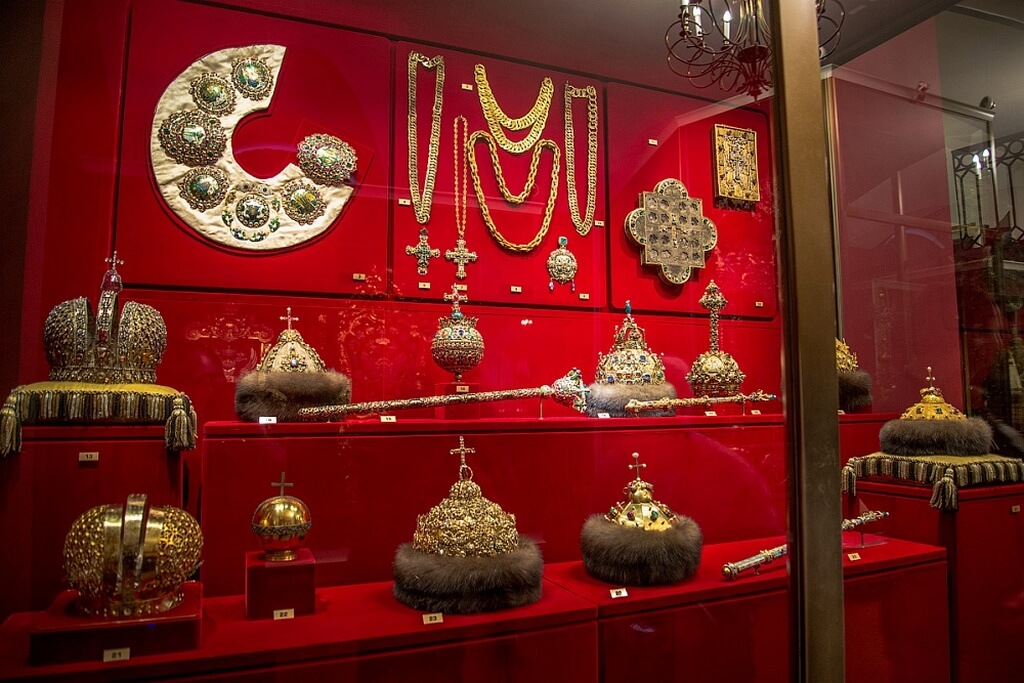


Moscow is rich in sights and historical monuments. Among all the variety of interesting objects, it is worth highlighting the Diamond Fund, which houses a collection of works of jewelry art. The Museum is incredibly popular among guests of the capital, so it is not so easy to get into it. Currently, the Diamond Fund is located on the territory of the Kremlin. There are always a lot of people who want to visit the Museum, and on weekends or on holidays the number of people only increases. History of the collection the Diamond Fund contains unique jewelry pieces, rare instances of precious stones, nuggets of precious metals. This is one of the few collections in the world that contains Royal symbols of power. The history of the Museum goes back to the era of Peter The great. According to his decree, a separate room was allocated for storing valuable state items, which later became known as the Diamond room. It contained state regalia, ceremonial jewelry, and order badges. Members of the Emperor's family wore them for special occasions. Over the years of the Romanovs ' rule, the Treasury was constantly replenished with new jewels. During this time, a lot of jewelry was made, richly decorated with precious stones. The Russian court was distinguished by pomp and splendor. This was especially true during the reigns of Catherine II and Elizabeth. The Russian court was one of the most brilliant in Europe. The best jewelers worked in the Palace. Among them J. pauzie, G. Akarta, the son and the father Dyual. Now at the exhibition you can admire their works of the highest jewelry skill. The formation of the chamber-Board, which was supposed to be engaged in the accounting and storage of valuables, was started in the first half of the eighteenth century after the decree of Peter the Great on the creation of the State repository of crown values. The Department was officially established in 1719. The regulations of the chamber Board listed all the relics that were available at that time. The order of their storage was also established. Peter the Great's ideas about symbols of state power later extended to other values. By the way, the Charter and staff of the chamber Board changed at each Board. This was the Foundation of the Russian Diamond Fund. Crown jewels were stored in a special room of the Imperial Majesty. The room was even called the Diamond or Diamond room. During the reign of Catherine II, the Grand bedroom of the Empress was converted to accommodate the storage. The room was spoken of as the richest Cabinet of jewels. The interior of the room was created by the architect Feltin. Further fate of the collection after the beginning of the First world war, crown jewels, Imperial regalia, the family book of the Imperial House and other valuable documents were transported to the Moscow Kremlin. Here they were placed in the Crown hall of the Armory. Currently, the Moscow Kremlin Diamond Fund includes a unique collection of diamonds, diamonds and jewelry. Over the entire period of its existence, the collection has been supplemented with decorations, rare gems, and other valuable items. A huge contribution to the development of the Museum "Diamond Fund" was made by the experimental jewelry laboratory. It was its employees who carried out restoration work to restore the destroyed values. They also worked on the Small and Large Imperial crown. More than a hundred jewelry items were included in the exposition of the Moscow Kremlin Diamond Fund. Currently, all the exhibits are located in two halls. The first contains diamonds, diamonds, jewelry, and nuggets. Thus, one of the showcases contains semi-precious and precious stones from all over the former Soviet Union. Also here you can see a map of Russia made of diamonds. Then in the showcases are real diamonds-giants and examples of their cutting are presented. There are also modern art objects in the hall. In the center are placed nuggets of platinum and gold, which have their own names – "Mephistopheles", "Camel", "Big triangle". In the second hall, historical values are presented. Among them there are products of jewelry masters of the 18-19 centuries, which before the revolution were considered the crown values of Russia. The most famous and valuable exhibits of the Diamond Fund in Moscow are crown jewels: the power, crown and scepter. The crown of Catherine II was made in 1762 for the coronation ceremony. It is a real symbol of the entire Museum. The crown is decorated with 5 thousand diamonds and 75 large pearls. And its top is crowned with a red spinel (72 carats). The height of the cross is 27.5 cm, and the length of the lower circumference is 64 cm. After Catherine II, the crown was used for coronation by all Russian emperors. In the same window, next to the Large Imperial crown, there is also a Small crown, as well as a scepter with the famous "eagles" diamond, which weighs 189.62 carats. The small crown was made in 1856 by order of Maria Alexandrovna for her coronation. Here in the window is the Power, which is a polished smooth ball, wrapped in a garland of diamonds. On its surface there is an Indian diamond (42.95 car.). On top of the crown Is an amazing sapphire from Ceylon in 200 carats. The weight of the Power is 861 g., and its height with the cross reaches 24 cm. ₽ Grown diamond. Prices will surprise you! 585 white gold earrings... The scepter, like other attributes, was a symbol of power. It is decorated with a diamond "eagles", about which there were legends. According to the official version, the stone was given to Catherine on her name day by the count. According to another version, the diamond was purchased by the Empress herself, but in order not to be accused of waste, she played a show with a gift. One way or another, everything happened – it is unknown. But the stone was embedded in the scepter, which earned him fame. Three valuable relics-the blue sapphire in the state, the Orlov diamond in the scepter, and the red spinel in the crown-symbolize the colors of the Russian flag. Other jewels Among the exhibits of the Diamond Fund you can see another famous diamond – "Shah". It was once given to Nicholas I by the Shah of Iran as a reconciliation for the murder of the Russian Ambassador. It is worth noting that the murdered was not just the Ambassador, but the famous Russian writer Griboyedov, whose monument can be seen on Chistye Prudy in Moscow. Also in this Department of the Diamond Fund in Moscow are the Royal jewelry. One of them is a bracelet with a diamond "Alexander", which belonged to Alexander I. Here you can also see the brooch of Catherine the Second, made of gold and silver, decorated with numerous diamonds, in the form of a bouquet of roses. No less beautiful is the berry-shaped pendant made of large tourmaline. In the halls of the Museum there are a lot of jewelry made of silver, gold, precious stones and diamonds. Excursions to the Diamond Fund always impress guests. Where else can you see such a rich collection of jewelry. Products of modern masters in the last Department of the Museum as exhibits are products of modern jewelers. Beautiful jewelry made of gold with topazes, amethysts, diamonds and emeralds simply amaze with beauty. Modern exhibits do not have such a loud history as the items of the previous Department, but they are also very beautiful, because modern jewelers use technologies that were simply not available to masters from the past. In General, all the exhibits are impressive and striking in beauty, to understand this, you should go on a tour to the Diamond Fund. You can read a lot and admire the beauty of products in photos on the Internet, but no picture conveys their true beauty. All this must be seen with your own eyes. To Sum up, it is worth noting that the Museum currently has seven historical, incredibly valuable stones on display: the Orlova Diamond adorns the monarch's scepter. The stone was found in India. Its peculiarity is an indescribably beautiful greenish-blue tint. The diamond has 180 faces. The "Shah" diamond is a yellow crystal that has not been cut. It bears the names of three of its owners. A flat portrait diamond set in a gold bracelet with emeralds. Red spinel in a Large crown. The stone was installed in the product just before the coronation of Catherine the Second. Spinel differs not only in its large size, but also in its purity and transparency. By the way, the cost of the Imperial crown has not been determined yet because of the uniqueness of the product. A Columbian emerald with a stepped cut that crowns a stunning brooch. The stone was found in the fifteenth century, but it only came to Russia at the beginning of the nineteenth century. Ceylon sapphire is considered the largest in the world. It adorns an old nineteenth-century brooch. Olive-green chrysolite was once found on an island in the Red sea. The stone was cut in a special way, which creates a feeling of its radiance. In the twentieth century, after the discovery of Yakut diamonds, the collection was significantly expanded with new exhibits: "big dipper", "Star of Yakutia" and others.